
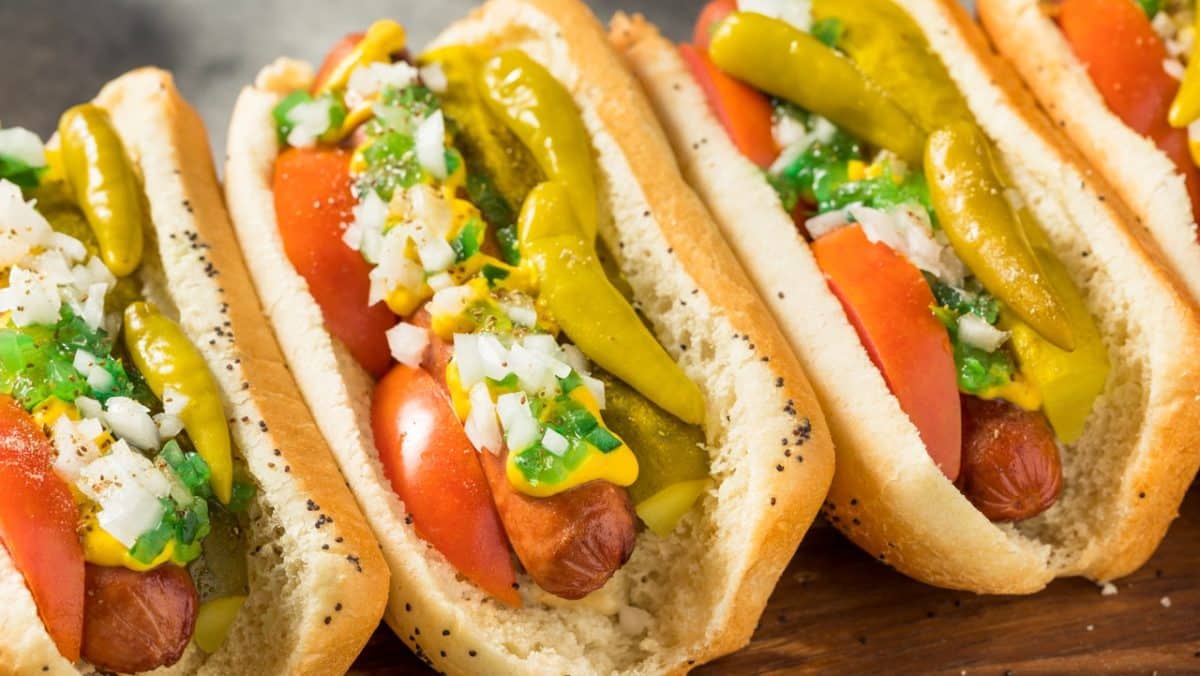
As the Democratic National Convention convenes in Chicago this week, one of the city’s best-known symbols is getting renewed attention: the hot dog that locals insist is uniquely theirs. Beyond being a festival food or ballpark staple, the recipe traces back to hard times and immigrant-run street carts — a piece of culinary history that still shapes how Chicagoans eat today.
Two long-established Chicago businesses are central to that story. Vienna Beef, a local sausage maker founded in the 19th century, points to the 1930s as the moment when street vendors began piling affordable franks with plentiful toppings to turn a cheap snack into a satisfying meal. Nearby, the restaurant chain Portillo’s — an Illinois-born brand with decades of history in the city — describes the construction and cultural role of the dog as part of Chicago’s food identity.
The appeal was practical: at a time when money was scarce, vendors could sell a filling sandwich for a few cents while stretching a small investment with inexpensive vegetables and condiments. That combination of price and abundance helped the style spread from street carts to restaurants and ballparks across the region.
Caramel, butterscotch, toffee: how their differences affect your desserts
McDonald’s rebrands Twitter to honor Bubba Wallace after his first NASCAR Cup win
What goes on a Chicago-style hot dog:
- Yellow mustard — the base flavor.
- Neon green sweet relish — a distinctive, brightly colored touch.
- Chopped onion — for bite and texture.
- Fresh tomato slices — typically placed on the side of the dog rather than piled on top.
- Two sport peppers — small, tangy chiles placed opposite the tomato.
- Pickle spear — a tangy counterpoint to the other toppings.
- Celery salt — a finishing seasoning sprinkled over everything.
- Poppyseed bun — the traditional vessel for the assembled frank.
There is one topping notably absent from the list: ketchup. Many purveyors and longtime fans consider it unnecessary when fresh tomato and the other condiments are present.
How a Chicago dog is typically assembled
| Step | Action | Why it matters |
|---|---|---|
| 1 | Steam the hot dog and the bun | Keeps the sausage juicy and softens the poppyseed roll |
| 2 | Place the frank in the split bun | Creates the base for orderly topping placement |
| 3 | Add yellow mustard, then green relish and chopped onion | Builds layers of savory, sweet and sharp flavors |
| 4 | Position tomato slices on one side and sport peppers on the opposite | Keeps textures distinct and balances acidity |
| 5 | Lay in a pickle spear and finish with a dusting of celery salt | Completes the flavor profile with brine and aromatic seasoning |
The result is a compact sandwich layered with contrasting tastes and textures — bright relish, sharp onion, cooling tomato, fiery peppers, and salty pickle — all carried by a soft, seeded roll. That careful choreography of ingredients is part of the regional lore: many Chicagoans will insist there is a right and wrong way to build the dog.
Beyond recipes, the hot dog has symbolic weight for the city. It evokes immigrant entrepreneurship, Depression-era resilience and a working-class food culture that became an everyday luxury through smart, inexpensive additions. For visitors and locals alike this week, spotting the local style at a street vendor, diner or stadium will be as much a part of the Chicago experience as any political event.
Whether you call it an institution or a simple meal, the Chicago-style hot dog remains a culinary touchstone — and, for many, a tasty reminder of how food can carry history on a bun.
Irish whiskey: approachable bottles new drinkers should try today
Fishtown restaurants ranked: must-visit spots locals are raving about










