Show summary Hide summary
Peach season demands a small but decisive kitchen skill: knowing how to break down a ripe fruit cleanly so you waste less and get the best texture for eating, grilling or preserving. A few simple moves — and the right approach depending on the variety — change a sticky, pulpy chore into a quick, tidy step that improves pies, salads and snacks alike.
Tell a ripe peach from an underripe one
Before you reach for a knife, check the fruit. A ripe peach yields slightly to gentle pressure and gives off a sweet, floral aroma near the stem. Avoid fruit that’s rock-hard or that smells fermenting; both will affect texture and flavor.
Caramel, butterscotch, toffee: how their differences affect your desserts
McDonald’s rebrands Twitter to honor Bubba Wallace after his first NASCAR Cup win
Look at the skin too. Uniform color and a little softness around the seam are good signs. Overly bruised spots may be trimmed away, but deep bruising can mean the fruit is past its prime.
Freestone versus clingstone: why it matters
The easiest factor to consider when preparing peaches is the pit type. With freestone varieties, the flesh separates from the pit plainly — halving and twisting usually releases the stone cleanly. Clingstone peaches hold fast to their pits and often require sawing around the stone or scooping to preserve as much flesh as possible.
For everyday use, freestones save time and give neater slices. If you’re working with clingstones, expect a little more cutting and trimming, especially when dicing for jams or chutneys.
Step-by-step: halve, pit, slice (quick reference)
| Step | What to do | When to use |
|---|---|---|
| 1 — Score | Run a sharp paring knife around the peach through the seam from stem to bottom, rotating the fruit. | All peaches |
| 2 — Twist or pull | Grip both halves and twist in opposite directions; if it separates, remove the pit by hand. | Freestone |
| 3 — Cut away | For clingstones, slice lengthwise around the pit, then cut the flesh away in segments or scoop it out. | Clingstone |
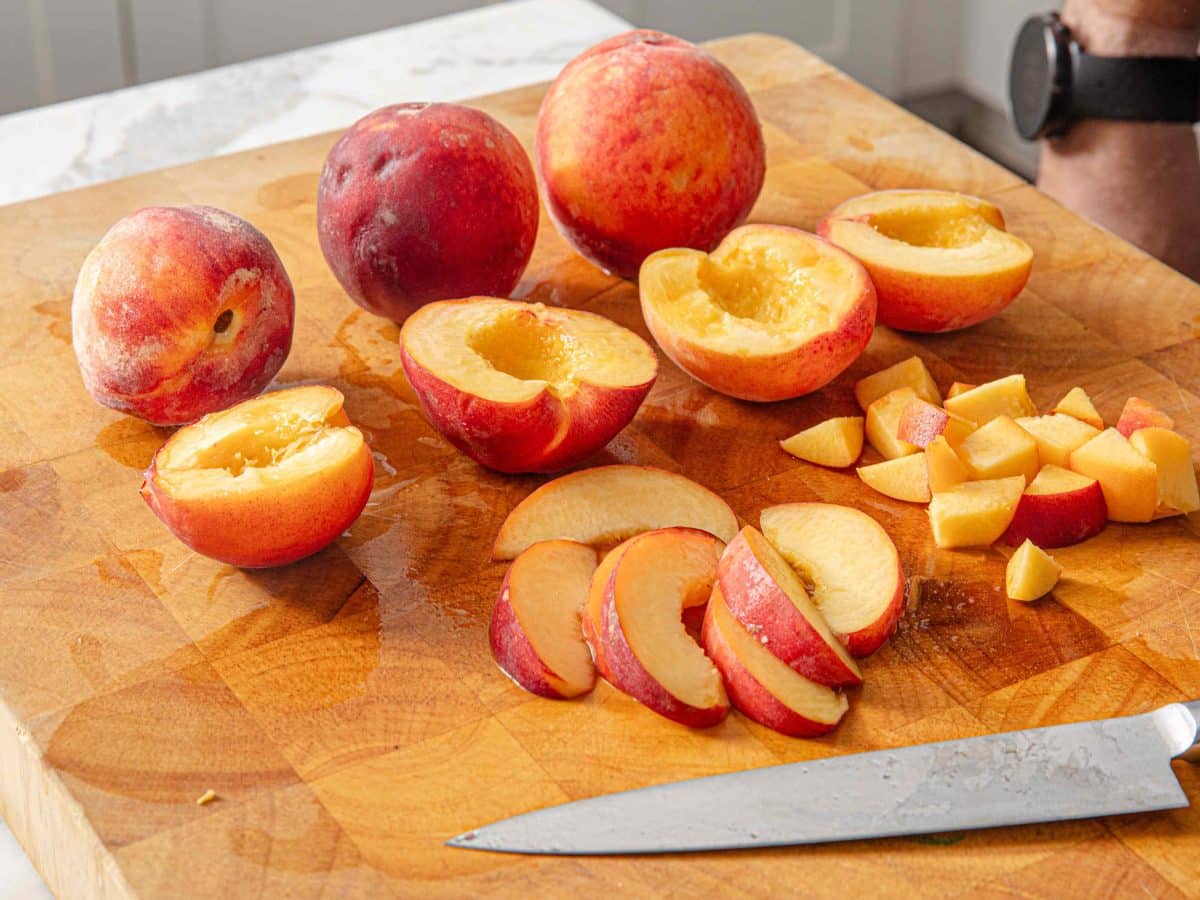
| 4 — Slice or dice | Lay halves flat, slice crosswise for wedges or cut into strips then cubes for dicing. | Slices, salads, pastries |
| 5 — Store | Refrigerate for short-term use, or freeze on a tray before bagging to preserve texture. | Storage/preserving |
That table gives a quick road map, but a few practical points make the work cleaner.
- Tools: a sharp paring knife and a small cutting board are enough. For clingstones, a serrated knife or spoon can help.
- Peeling: If you need peeled peaches (for canning or smooth desserts), briefly blanch in boiling water for 20–30 seconds, then plunge into ice water — the skin slips off easily.
- Soft fruit: Very ripe peaches can smear when sliced. Chill them briefly to firm the flesh for neater cuts.
When dicing, aim for uniform pieces so cooking time is consistent — important in compotes and tarts. For grilled peaches, halve and leave the skin on for structure; coat lightly with oil to prevent sticking.
Storage and food-safety notes
Peaches store best unwashed in the refrigerator for up to three days once ripe. If you plan to freeze, halve and remove pits, then place cut fruit on a baking sheet to flash-freeze before transferring to a sealed bag — this prevents clumping and preserves texture.
Discard fruit with sour odors or large areas of darkened flesh. Even when trimmed, off-flavored peaches can alter a recipe’s taste.
Learning a couple of simple techniques — recognizing ripeness, choosing the right cut for the job, and using the proper tool — keeps more of the fruit on the plate and less in the bin. With peak season here, a few moments at the cutting board will pay off across every picnic, skillet and jar you make.
Irish whiskey: approachable bottles new drinkers should try today
Fishtown restaurants ranked: must-visit spots locals are raving about